How Atmospheric Water Generation Really Works — A Simple Explanation
Introduction
If you've come across the term "atmospheric water generation" while researching off-grid water generation from atmosphere systems, you've probably wondered whether it's real science or just marketing language. The good news: it's a genuinely established process, used in everything from military field equipment to industrial dehumidifiers. What's changed in recent years is that guides like the Water Freedom System have made a simplified, home-buildable version of this technology accessible to everyday households — no engineering background required.
This article breaks down exactly how atmospheric water generation (AWG) works, what makes it possible, and what realistically affects how much water a home-built system can produce. If you're new to the product itself, start with our Water Freedom System review for an overview of what's included in the guide.
The Basic Science: It's the Same Thing as Dew
Every morning, dew forms on grass, car windshields, and outdoor furniture. That's condensation — water vapor in the air cooling down until it turns into liquid droplets. Atmospheric water generation takes that natural process and engineers it into something controllable and continuous.
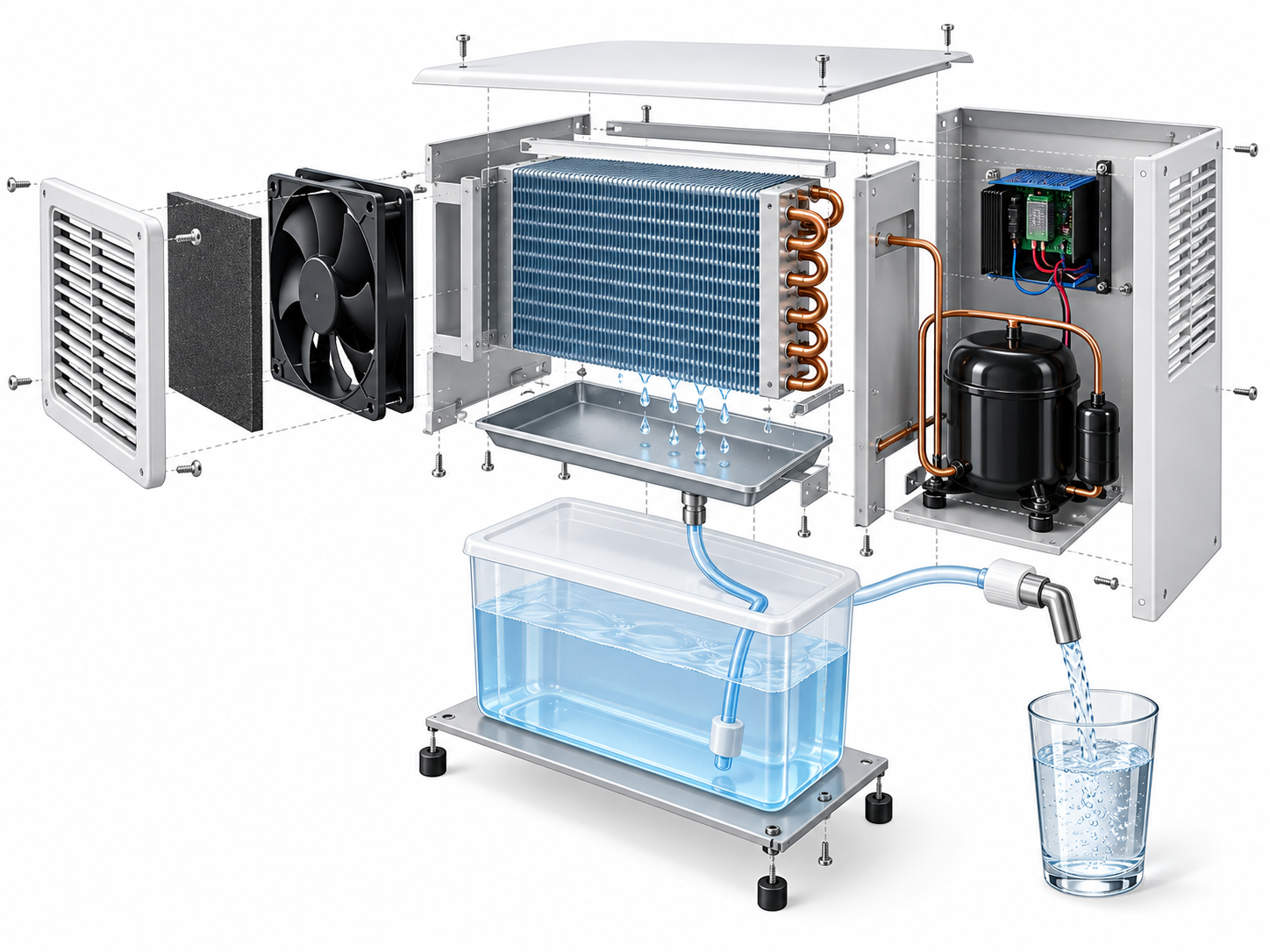
Air always contains some amount of water vapor, even in places that feel dry. The amount varies based on temperature and relative humidity, but it's almost never zero. AWG systems are built around three core steps:
- Drawing in air — A fan or intake pulls ambient air into the unit.
- Cooling the air below its dew point — This is the critical step. Once air is cooled enough, it can no longer hold onto all its moisture, and water vapor condenses into liquid.
- Collecting and filtering the water — The condensed water is gathered in a reservoir and passed through a filtration stage to make it usable for drinking or cooking.
This is fundamentally the same principle used in a household dehumidifier — the difference is that AWG systems are designed specifically to collect and purify the water they produce, rather than just removing humidity from a room.
What Actually Affects Output
This is the part that most marketing pages gloss over, but it matters a lot if you're evaluating a system like the Water Freedom System for your own household. Three variables determine how much water any AWG setup — commercial or DIY — can realistically produce:
1. Relative humidity. Higher humidity means more water vapor is available in the air to condense. Coastal regions, the southeastern U.S., and tropical climates tend to see notably better AWG performance than arid regions like the desert Southwest.
2. Temperature. Warmer air can hold more moisture than cold air, but the cooling mechanism also has to work harder to hit the dew point. There's a balance point where AWG systems perform best — generally moderate-to-warm temperatures combined with decent humidity.
3. Airflow and condenser surface area. The more air a system can move across a cooled surface, the more opportunities it has to extract moisture. This is one reason commercial units are often larger and more powerful than small DIY builds — more surface area and airflow generally means more water collected per hour.
Why Climate Matters More Than the Build Itself
A common misconception is that AWG systems either "work" or "don't work." In reality, it's a spectrum. The same unit placed in humid Florida versus dry Arizona will produce very different results. This is why guides that teach the underlying method — rather than promising a fixed daily output regardless of location — tend to set more realistic expectations.
For households in moderate-to-humid climates, a well-built DIY unit can meaningfully supplement daily water needs. For those in very dry climates, indoor placement near naturally humid areas (kitchens, bathrooms, laundry rooms) or running the system during higher-humidity parts of the day (typically early morning) can help improve results. We explore practical placement strategies more in our guide to building an off-grid water backup at home.
How This Differs From Water Filtration
It's worth clarifying a distinction that trips a lot of people up: atmospheric water generation is not the same category of technology as water filtration.
- Filtration systems clean water that already exists — from a tap, well, or stored source.
- AWG systems create a new water source out of ambient air moisture, independent of pipes, wells, or municipal supply.
This is why AWG has become particularly relevant in off-grid, emergency preparedness, and homesteading contexts — it doesn't depend on infrastructure at all. A drought that dries up a well or a boil-water advisory affecting the tap has no bearing on a system that pulls its water from the air. That independence is especially valuable in emergency situations where municipal water is disrupted.
Is This "Free Energy" or a Miracle Device? No — And That's Fine
It's worth being direct about something: air-to-water technology isn't magic, and it isn't unlimited. It requires energy to run the cooling/condensing mechanism, and output is bounded by the physical humidity available in a given location at a given time. Anyone promising unlimited water regardless of climate or conditions is oversimplifying the science.
What's realistic is this: AWG is a legitimate, well-understood process capable of producing a meaningful amount of usable water, particularly as a supplemental or backup source, with output that scales with humidity and system size. That's a genuinely useful capability — it just needs to be understood with accurate expectations rather than sold as a cure-all.
Why DIY Guides Have Gained Popularity
Commercial AWG units marketed for home use can run into the thousands of dollars, largely because of built-in automation, larger cooling systems, and enclosure design. Guides like the Water Freedom System take a different approach: they teach the same underlying condensation principle using accessible parts, at a fraction of the cost, with the tradeoff being that you build and maintain it yourself.
For people comfortable with a basic weekend project, this can be an appealing middle ground — you get to understand exactly how your water is being produced, rather than relying on a sealed commercial appliance. If you want to see what's actually included — parts list, diagrams, and bonus guides — check the official Water Freedom System guide for the complete breakdown.
Final Thoughts
Atmospheric water generation isn't science fiction — it's applied condensation science that's been used in various forms for decades. Understanding how it actually works, and what affects its output, is the best way to set realistic expectations before building your own system. Whether you're exploring this for sustainability reasons, emergency backup planning, or general curiosity about off-grid water generation from atmosphere methods, the core takeaway is simple: it's a real, physics-based process — just one that performs differently depending on where you live and how you use it.
Ready to go deeper? Learn how to layer AWG into a full off-grid water plan or see the latest offer for the Water Freedom System on the official site.
Want the Full Step-by-Step Guide?
Build your own atmospheric water generator with illustrated instructions and a complete parts list.
Get Instant Access →Instant download · 60-day guarantee